
What Are Pharmacokinetics Services?
Published: 05.MAR.2026



Pharmacokinetics services play a critical role in modern drug development by helping researchers understand how a drug behaves in the body and how to optimize its safety and efficacy. From early discovery to late-stage clinical trials, pharmacokinetic (PK) studies provide essential data that support smarter decision-making, reduce development risks, and increase the chances of regulatory and commercial success.
What Are Pharmacokinetics Services?
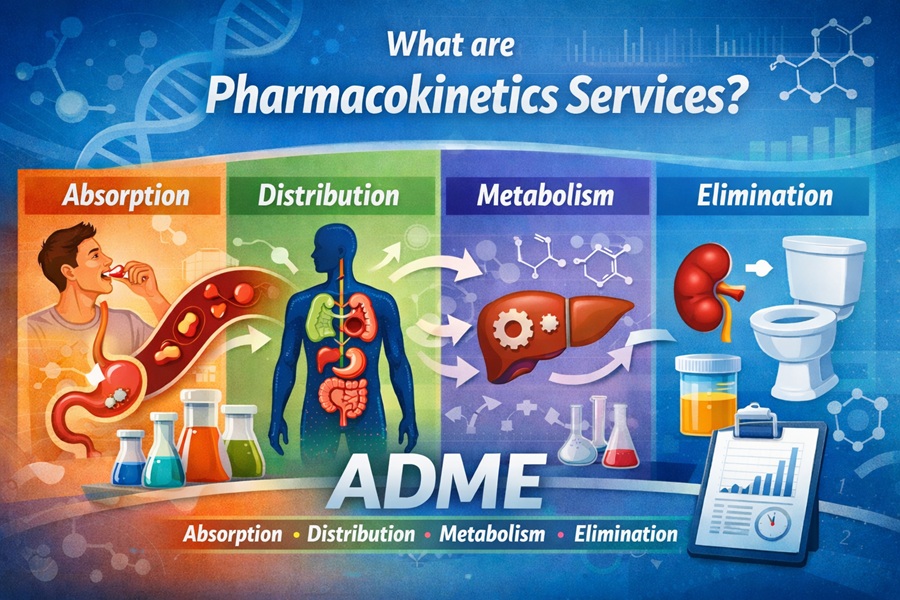
Pharmacokinetics Services encompass a range of scientific activities designed to evaluate the absorption, distribution, metabolism, and excretion (ADME) of drug candidates. These services generate quantitative data on how a compound moves through the body over time, typically expressed through parameters such as bioavailability, clearance, half-life, and volume of distribution.
PK studies are conducted in both preclinical and clinical settings and are often integrated with pharmacodynamic (PD), toxicology, and bioanalytical data. Together, these insights form the foundation for dose selection, formulation strategy, and overall development planning.
Why Pharmacokinetics Matters in Drug Development
A promising compound can fail if it does not reach the target tissue at the right concentration for the right duration. Pharmacokinetics Services help answer fundamental questions, such as:
● How quickly is the drug absorbed?
● How long does it remain active in the body?
● How is it metabolized and eliminated?
● Does exposure scale predictably with dose?
By addressing these questions early, development teams can avoid costly late-stage failures and focus resources on the most viable candidates.
Role of PK Studies in Preclinical Development
In preclinical development, PK studies support compound selection and optimization. During hit-to-lead and lead optimization phases, Pharmacokinetics Services help medicinal chemists balance potency with drug-like properties.
Key contributions at this stage include:
● Comparing exposure profiles across multiple lead candidates
● Identifying metabolic liabilities and clearance risks
● Supporting structure–activity relationship (SAR) decisions
● Informing formulation strategies for in vivo studies
Preclinical PK data also play a crucial role in selecting starting doses for first-in-human (FIH) studies and preparing regulatory submissions.
Supporting Smarter Dose Selection in Clinical Trials
In clinical development, Pharmacokinetics Services are essential for designing safe and effective dosing regimens. PK data collected during Phase I studies help determine dose proportionality, accumulation, and interpatient variability.
As development progresses, population pharmacokinetics and PK/PD modeling enable:
● Optimization of dosing frequency and strength
● Identification of subpopulations requiring dose adjustments
● Assessment of drug–drug interaction risks
● Support for label claims and regulatory discussions
These insights allow sponsors to move beyond trial-and-error dosing toward data-driven, patient-centric strategies.
Integration with Modeling and Simulation
Modern Pharmacokinetics Services increasingly incorporate advanced modeling and simulation approaches. Physiologically based pharmacokinetic (PBPK) models and population PK analyses help predict clinical outcomes, even with limited data.
These tools support:
● Translating animal data to humans
● Predicting exposure in special populations (pediatrics, renal or hepatic impairment)
● Evaluating alternative formulations or routes of administration
● Reducing the number of required clinical studies
As a result, modeling-enabled PK strategies can significantly shorten development timelines and reduce costs.
Outsourcing Pharmacokinetics Services: A Strategic Advantage
Many pharmaceutical and biotech companies choose to outsource Pharmacokinetics Services to specialized CROs. External providers offer access to experienced scientists, validated bioanalytical platforms, and regulatory-ready workflows without the need to build in-house infrastructure.
Outsourcing PK studies can provide:
● Faster turnaround times
● Scalable resources across development stages
● Compliance with global regulatory standards
● Seamless integration with toxicology and bioanalysis
For small biotech companies and virtual R&D teams, outsourced PK expertise is often a key enabler of progress.
Conclusion
Pharmacokinetics Services are a cornerstone of smarter, more efficient drug development. By revealing how a drug behaves in the body, PK studies inform critical decisions on candidate selection, dose optimization, and clinical strategy. When integrated with modeling, toxicology, and clinical data, pharmacokinetics helps reduce risk, improve patient safety, and accelerate the journey from discovery to market. 💊
Filed in: / Health & Sports / Pharmacokinetics
Advertising